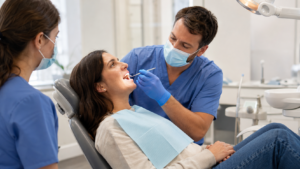
Dental implants support replacement teeth from within the jawbone. Traditional bridges use neighboring teeth for support. Conventional dentures are removable appliances that replace some or all missing teeth.
These options differ in how they are supported, what treatment involves, and how you care for them. They can also overlap: implants may support a crown, bridge, or denture.
When comparing dental implants vs. bridges vs. dentures, consider your clinical needs and daily care preferences. At Twin Oaks Dental Studio in Valley Park, MO, we explain the available choices and recommend care based on your oral health, priorities, and individual needs.
Tooth Replacement Options at a Glance
| Option | Support | Fixed or removable? | Main consideration |
| Dental implant-supported replacement | Implants placed in the jawbone | Depends on the restoration | Requires implant placement and assessment of healing and bone support |
| Traditional tooth-supported bridge | Natural teeth next to the gap | Fixed | Supporting teeth generally need preparation for crowns |
| Conventional partial denture | Remaining teeth and oral tissues, depending on the design | Removable | Can replace teeth in different areas; requires daily removal and cleaning |
| Conventional complete denture | Gum tissues and the underlying ridge | Removable | Replaces all teeth in an arch; fit and adaptation need ongoing attention |
Here, “traditional bridge” means a bridge supported by natural teeth. “Conventional dentures” means removable dentures that do not use implants.
Dental Implants: Support Within the Jawbone
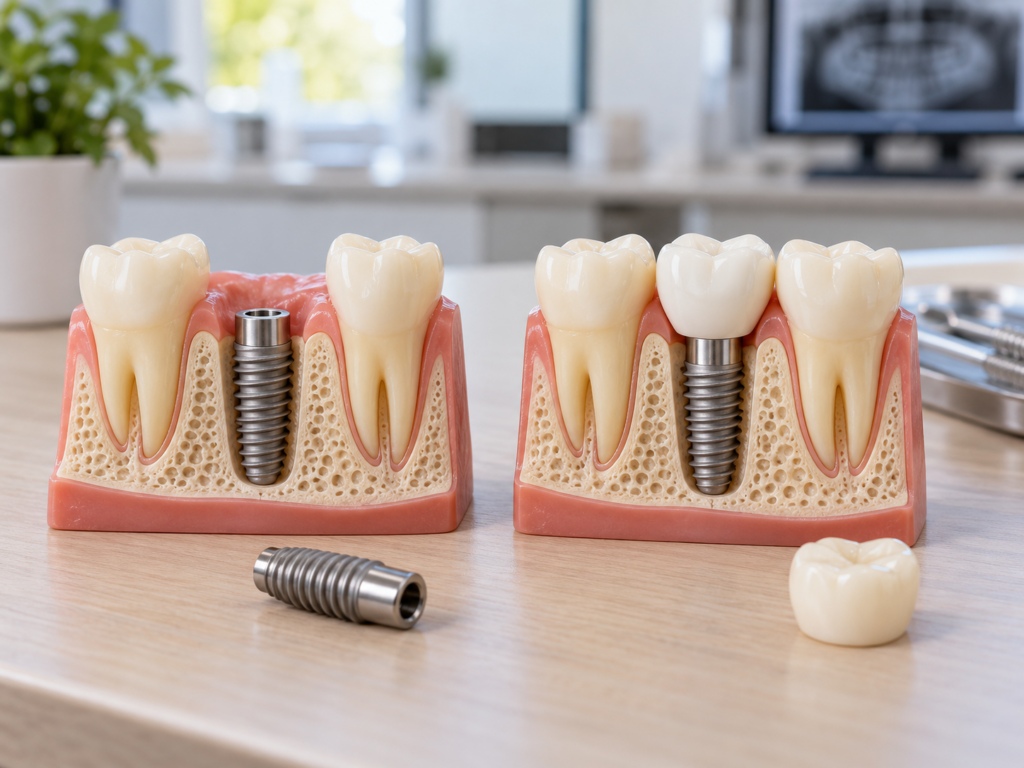
A dental implant is a small post placed surgically in the jawbone. For one missing tooth, it typically supports a crown through a connector called an abutment. Multiple implants can also support other replacement restorations.
An implant-supported crown can replace a tooth without using its neighbors as bridge supports. This may be worth discussing when the adjacent teeth are healthy, although it does not automatically make an implant the right choice.
Implant treatment involves evaluating your gums, available bone, medical history, and other factors that affect candidacy. After placement, the surrounding bone heals around the implant in a process called osseointegration. The dentist determines when the site is ready for the planned restoration.
Twin Oaks Dental Studio offers dental implants, including an individualized treatment sequence that can involve placement, the connector, and a final crown. Your consultation should clarify which steps are recommended for you.
Traditional Bridges: Support From Neighboring Teeth
A traditional bridge fills a gap with an artificial tooth or teeth connected to crowns on the natural teeth beside it. The finished restoration is fixed in place rather than removed for daily cleaning.
The condition of those supporting teeth matters. They need to be suitable for the additional role they will play.
Preparing a traditional bridge generally involves reshaping the supporting teeth to accommodate crowns. This is an important tradeoff to understand, particularly if those teeth otherwise need little treatment. If neighboring teeth already need crowns, that can also be relevant to the discussion.
A traditional bridge does not require implant placement, but it still needs careful planning, fitting, and maintenance. Other bridge designs exist, including implant-supported bridges, so ask which type your dentist is describing.
Conventional Dentures: Removable Tooth Replacement
A partial denture replaces some missing teeth while fitting around the teeth that remain. A complete denture replaces all teeth in the upper or lower arch.
A partial denture may address gaps in different areas of the mouth through one removable appliance. A complete denture provides replacement teeth when an entire arch needs restoration.
Conventional dentures do not require implant placement. However, the overall plan may still include extractions, treatment of remaining teeth, or healing before the final appliance is fitted.
Dentures can take time to get used to. Your dentist checks the fit and makes appropriate adjustments. Persistent soreness or a change in fit should be assessed rather than accepted as something you simply have to tolerate.
Implants, Bridges, and Dentures Can Work Together
The word “implant” describes the supporting foundation. “Bridge” and “denture” describe types of replacement teeth. These are not always separate treatment categories.
For example, implants may support a bridge replacing several teeth or provide support or retention for a denture. The attachment design determines whether a patient removes the restoration or whether it stays fixed in place.
This also means replacing several teeth with implant treatment does not necessarily require one implant for every missing tooth. The number and position of implants depend on the restoration and clinical plan.
These are general treatment possibilities. Your dentist can explain which designs are appropriate and available for your case.
What Factors Guide the Recommendation?
Number and Location of Missing Teeth
One gap, several separate gaps, and an entire arch of missing teeth require different planning.
Your dentist considers the available support, appearance, bite, and space for the restoration. Counting missing teeth alone does not determine the answer.
Condition of Remaining Teeth and Gums
Supporting teeth must be assessed before planning a tooth-supported bridge or partial denture. Decay, gum disease, or existing damage may need attention first.
Conservative planning also considers whether a tooth can be preserved. If a damaged tooth is still present, discussing replacement should not bypass evaluating reasonable ways to save it.
Bone Support and General Health
Implant planning includes assessment of the jawbone and your health history. Medical conditions, medications, and habits such as smoking can affect healing and should be discussed openly.
Insufficient bone does not provide an automatic answer either way. Your dentist needs to assess the site and explain whether additional treatment or a different approach should be considered.
Your Preferences and Home Care
Tell your dentist whether you prefer a fixed restoration, are comfortable removing an appliance, or have difficulty using particular cleaning tools.
The recommended design should account for maintenance as well as tooth replacement. Ask the team to demonstrate the cleaning routine before you commit to treatment.
What Does Treatment Involve?
The sequence varies, but understanding the broad differences helps you plan.
- Implant treatment involves evaluation, surgical placement, healing assessments, and creation and attachment of the planned restoration.
- A traditional bridge involves assessing and preparing the supporting teeth, recording the area, and fitting the finished restoration.
- Dentures involve records, design and fitting appointments, and adjustments. Extractions or healing may add stages when needed.
Ask whether a temporary replacement is appropriate while treatment is underway. Also discuss what could change the expected sequence.
Avoid assuming that avoiding implant surgery means treatment is immediate. Each approach needs planning, and the condition of your mouth affects timing.
How Does Daily Care Compare?
Fixed replacements still need cleaning around their supports and along the gumline. A bridge also needs cleaning underneath the replacement tooth, using floss or other aids recommended by your dental team.
Conventional dentures are removed for cleaning. You also need to clean your mouth and any remaining natural teeth. Follow the instructions for your denture’s materials and storage.
Every option needs follow-up. Visits allow the dentist to review the restoration, surrounding tissues, and changes in your dental health. Report looseness, damage, persistent discomfort, or a bite that feels different.
Comparing Costs Without Guessing
A useful estimate should reflect the complete recommended plan.
Ask what is included, whether preparatory treatment is needed, and which appointments or components are listed separately. For implant treatment, clarify whether the estimate covers placement, the connector, and the final restoration.
Ask about maintenance, adjustments, future repairs, and current payment arrangements rather than assuming coverage.
Comparing written plans can help you understand the recommendations and associated costs without relying on a generic price ranking.
Frequently Asked Questions
Are dental implants always better than bridges or dentures?
No option is best for every patient. The recommendation depends on oral health, available support, treatment needs, and preferences. Each approach has benefits and tradeoffs.
Does every missing tooth need its own implant?
Not necessarily. Multiple implants may support a bridge or denture. The appropriate number depends on the proposed restoration and individual anatomy.
Will a traditional bridge affect neighboring teeth?
Usually, its supporting teeth need to be reshaped for crowns. Ask how much preparation is anticipated and how their existing condition affects the recommendation.
Can I keep some natural teeth and wear dentures?
Yes. A partial denture is designed to replace missing teeth while accommodating those that remain. Your dentist assesses whether the remaining teeth can provide suitable support.
How long will treatment take?
The timeline depends on the restoration, healing, and any additional treatment. Your dentist can explain the expected stages without promising the same schedule for everyone.
Discuss Your Options Without Pressure
Twin Oaks Dental Studio provides tooth replacement options through its restorative and implant services. We explain recommendations, listen to your priorities, and help you understand the choices relevant to your mouth.
If you are considering replacing missing teeth, schedule a tooth replacement consultation. Together, we can review your dental health, discuss treatment tradeoffs, and plan an approach that fits your individual needs.